- CALL : (+1) 407-499-0530
- Main Office : (+1) 407-499-0530
Home » User Guides » NetSuite » Implementations » Choosing a Partner
How to Choose a NetSuite Implementation Partner: The Technical Vetting Guide
Buying NetSuite is easy; implementing it is where careers are made or broken.
For CIOs and Operations Leaders in the mid-market ($10M – $500M revenue), the risk isn’t the software. NetSuite is the gold standard for cloud ERP. The risk is the partner.
The market is flooded with “generalist” agencies that treat ERP implementation like a website setup. They promise the world in the sales cycle, only to deliver a broken environment that requires expensive rescue projects six months later.
This guide strips away the marketing fluff. We will focus on the technical and contractual realities of choosing a partner, ensuring you hire a team that can actually build the complex architecture your business needs.
For more information on implementations, check out our full NetSuite Implementation Guide.
What is a NetSuite Implementation Partner?
A NetSuite Implementation Partner is a certified third-party firm authorized by Oracle NetSuite to sell licenses, implement software, or develop custom applications.
Think of NetSuite as the raw materials—lumber, concrete, and steel. The Implementation Partner is the architect and builder. Even the best materials will collapse if the blueprint is flawed. These partners bridge the gap between “out-of-the-box” functionality and your specific business processes (e.g., complex revenue recognition, manufacturing routing, or warehouse automation).
The 3 Types of NetSuite Partners (And Which You Need)
Most buyers don’t realize that NetSuite partners fall into distinct business models. Your choice depends entirely on whether you need “configuration” or “deep code customization.”
| Partner Type | Business Model | Best For… |
| Solution Provider | Sales + Services: They sell you the NetSuite license and implement it. They are your “One-Stop Shop.” | Mid-market companies wanting a single contract and accountability. They handle the license renewal and the build. |
| Alliance Partner | Services Only: They do not sell the software. They only provide implementation staff. often large Global Systems Integrators (GSIs) like Deloitte or Capgemini. | Enterprise-level global rollouts. You buy the license from Oracle Direct, and hire these firms for massive workforce scale. |
| SDN Partner (SuiteCloud Developer Network) | Builders & ISVs: These are “Product” companies and high-level developers. They build “SuiteApps” (bundles) and write complex SuiteScript. | Companies with unique IP or complex SaaS needs. If you need a custom app built inside NetSuite, you need an SDN partner. |
1. Solution Providers (The General Contractors)
For 90% of mid-market businesses, this is the default choice. Because they earn margin on the software license, they have a vested interest in your long-term retention. If you churn, they lose their annuity. This aligns their incentives with yours.
2. Alliance Partners (The Big Battalions)
Alliance partners are typically necessary only for Fortune 1000 companies. Their rates are higher, and their teams are massive. If you are a $50M manufacturing firm, you will likely be a “small fish” to a large Alliance partner, risking lower prioritization.
3. SDN Partners (The Specialized Architects)
If your business requires functionality that simply does not exist in NetSuite (e.g., a proprietary crypto-payment gateway or a specialized healthcare compliance module), you need an SDN partner. These firms are not just consultants; they are software engineers who understand the “plumbing” of the NetSuite platform (SuiteScript 2.0) better than anyone else.
Critical Selection Criteria: Assessing Technical Competence
Beyond the glossy slide decks, you must evaluate the partner’s operational reality.
The “Bait and Switch” Staffing Clause
The most common complaint in the ERP industry is the “Bait and Switch.”
The Pitch: You are sold by a brilliant Solution Architect with 15 years of experience.
The Reality: Once the contract is signed, that Architect moves to the next sales call, and your project is handed to a “Junior Associate” learning NetSuite on your dime.
The Fix: Demand a “Named Resource” clause in your Statement of Work (SOW). Specify that the Lead Architect introduced during the sales cycle must remain billable on your project for at least 50% of the implementation hours.
Customization vs. Configuration (The “Code-First” Trap)
Weak partners love to write code immediately because it’s billable. Great partners try not to write code.
Configuration: Using native NetSuite switches and workflows (Safe, upgrade-proof).
Customization: Writing custom scripts (Riskier, breaks during upgrades).
Ask your potential partner: “How do you decide when to script vs. when to configure?” If they can’t articulate a framework for avoiding unnecessary code (Technical Debt), they are a risk.
Methodology: Agile vs. SuiteSuccess
NetSuite pushes a methodology called SuiteSuccess—a “waterfall” style approach with pre-configured dashboards. It is excellent for standard businesses. However, if you are building custom integration or complex apps, SuiteSuccess may be too rigid. You may need an Agile approach with 2-week sprints. Ensure your partner knows the difference and isn’t just forcing you into a template that doesn’t fit.
7 Questions to Ask a Potential NetSuite Partner
Cut through the sales script with these seven interrogations. Their reactions will tell you everything you need to know.

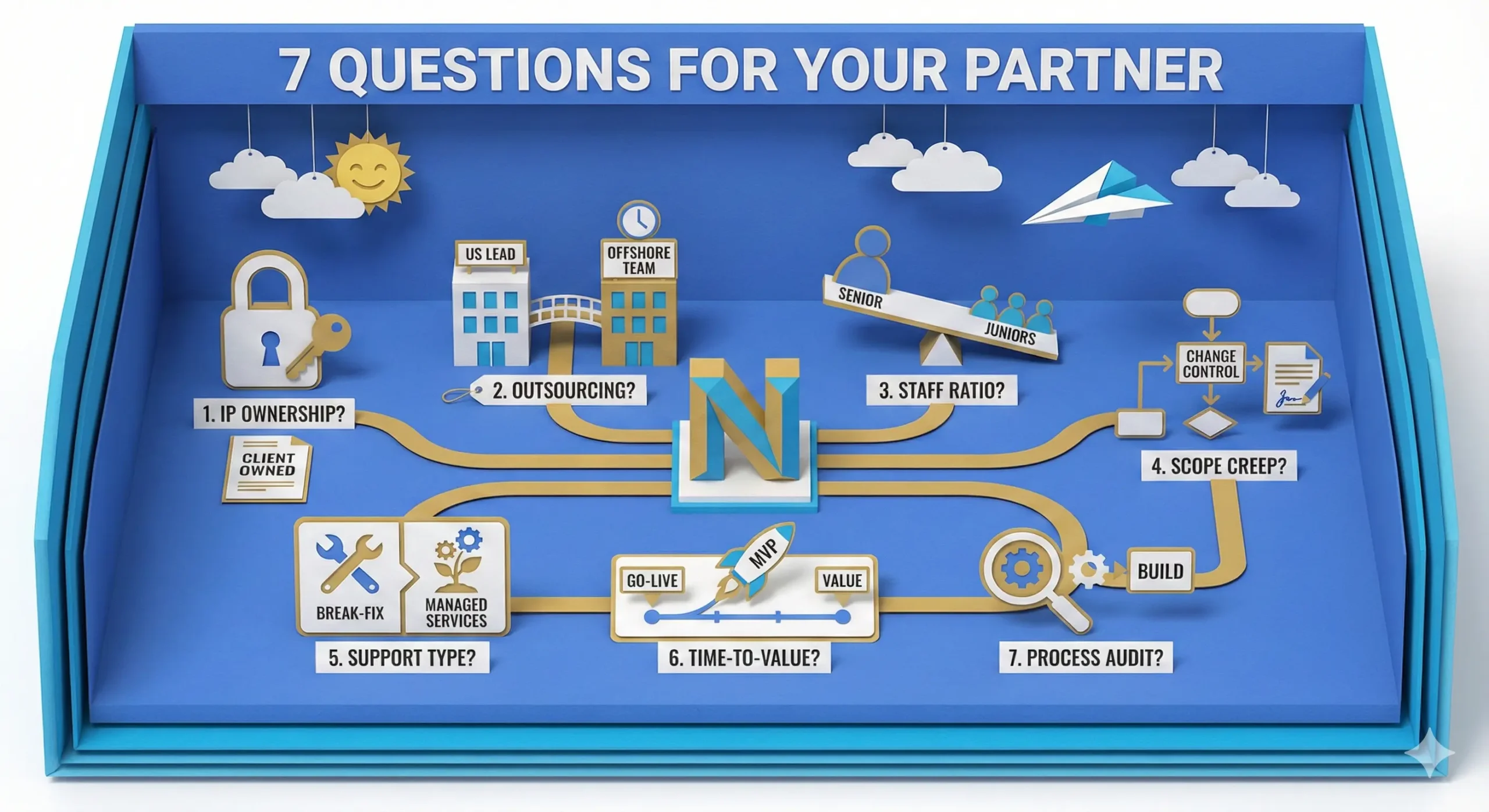
7 key questions for your NetSuite Implementation Partner.
1. Who owns the IP for any custom scripts you write?
Why ask: Some partners try to retain ownership of the custom code they build for you, licensing it back to you effectively as a “subscription.”
The Right Answer: “Work for Hire. You (the client) own the source code and IP upon payment.”
2. Do you outsource development to offshore teams or keep it in-house?
Why ask: Offshoring isn’t bad, but hidden offshoring is. If your developer is in a timezone 12 hours away, simple bug fixes can take days due to communication lag.
The Right Answer: Transparency. If they use offshore resources, they should have a dedicated U.S.-based Lead Developer managing the quality assurance (QA).
3. What is your ratio of Senior Consultants to Junior Associates?
Why ask: A firm with 1 Senior for every 10 Juniors is a “churn and burn” shop.
The Right Answer: A healthy ratio is 1 Senior to 3 Juniors.
4. How do you handle “Scope Creep” and Change Orders?
Why ask: Bad partners bid low to win the deal, then hit you with aggressive “Change Orders” for every minor adjustment.
The Right Answer: They should have a clear “Change Control Board” process. Minor tweaks should be absorbed; substantive changes require a formal, signed review.
5. Do you offer “Managed Services” or just break-fix support?
Why ask: After Go-Live, you don’t just need someone to fix errors; you need someone to help you optimize the system as you grow.
The Right Answer: They should offer a structured “Managed Services” plan with monthly strategic check-ins, not just a helpdesk ticket system.
6. What is your average “Time-to-Value”?
Why ask: “Go-Live” is just a date. “Time-to-Value” is when the system actually starts saving you money or improving efficiency.
The Right Answer: They should discuss phased rollouts. “We aim for a Minimum Viable Product (MVP) in 90 days, then iterate,” is a superior answer to “We go live in 9 months with everything.”
7. Will you audit our current processes before building?
Why ask: Automating a bad process just makes you fail faster.
The Right Answer: “Yes. We conduct a Business Process Review (BPR) to challenge your current workflows before we touch the keyboard.”
Red Flags in Partner Proposals
If you see these signals in the Statement of Work (SOW), do not sign.
“Yes to Everything”: A partner who doesn’t push back on your bad ideas is dangerous. You are paying them for expertise, not obedience.
Vague “Testing” Buckets: If the proposal lists “Testing – 20 hours” for a massive project, they are underestimating the User Acceptance Testing (UAT) phase. UAT is where projects die.
No “Technical Design Document” (TDD): For custom work, if they plan to code without first presenting a written TDD for your approval, they are “cowboy coding.”
Frequently Asked Questions
What is the difference between an SDN Partner and a Solution Provider?
An SDN Partner is a member of the SuiteCloud Developer Network; they specialize in building software products (apps) and complex integrations. A Solution Provider is primarily a reseller and implementer of the core ERP. You often need a Solution Provider for the main build and an SDN partner for specific, high-tech custom apps.
Should I customize NetSuite or use a standard workflow?
Always aim for standard workflows first. Customization creates “technical debt”—it is harder to maintain and can break during NetSuite’s bi-annual automatic upgrades. Only customize if the standard process costs you significant revenue or efficiency.
How much does a NetSuite implementation partner cost?
Implementation costs typically range from 1x to 3x the cost of your annual software license. If your license is $50,000/year, expect implementation to cost between $50,000 and $150,000 depending on complexity and data migration needs.
